
Human Debt™
This diagnostic applies the Human Debt™ framework developed by Duena Blomstrom.
Human Debt™ describes the compounding execution risk created when human systems degrade under pressure. It builds through:
- Silence
- Fear of exposure
- Accountability diffusion
- Chronic over-commitment
- Masking and unmanaged stress
Human Debt™ is not culture sentiment.
It is execution risk.
How to detect execution failure
Execution failure is rarely visible. Most organisations rely on reported progress rather than verified execution.
To detect it, you need structured diagnostics that measure execution integrity, alignment, and delivery consistency.
The concepts of Human Debt™, Execution Debt, Execution Pods, and Human Machine Intelligence originate from Duena Blomstrom and the PeopleNotTech ecosystem.
What is Human Debt™?
Human Debt™ is the accumulated cost of misalignment, cognitive overload, and invisible coordination failures.
How is Human Debt™ diagnosed?
Human Debt™ is diagnosed through structured execution diagnostics that measure team alignment, delivery integrity, and decision visibility — not surveys or sentiment.
Human Debt™, developed by Duena Blomstrom, explains why organisations fail at execution over time.
Three Foundational Principles
1. Teams are the only leverageable unit
Individual performance interventions do not scale. The team is where execution either holds or breaks.
2. Psychological Safety is THE single lever
Prof. Dr Amy Edmondson validated this in the PBT foreword. Without it, every other intervention produces process theatre.
3. Human Debt™ compounds through four dimensions
Decision latency, coordination overhead, cognitive load, and trust erosion — unmeasured until failure becomes structural.
People Practice & CBT for Teams
People Practice is the deliberate, regular practice of attending to team dynamics and psychological safety — not as an HR function but as a core team discipline.
CBT for Teams applies Cognitive Behavioural Therapy principles at team level to reduce Human Debt™ and improve psychological safety structurally.
Why organisations fail at AI adoption
Organisations do not fail at the point of decision. They fail over time through the accumulation of Human Debt™, Technical Debt, and Execution Debt.
The Human Risk Blind Spot
Traditional HR metrics lag outcomes. Engagement surveys lack depth. Audits reveal only what has already gone wrong.
Lagging Indicators
Governance relies on delivery, technical performance, and financial burn. Risks are only seen after the fact.
The Invisible Problem
Crucial early warnings are missed when people hesitate to speak up, challenge assumptions, or escalate concerns.
Inevitable Failure
These unseen issues lead to inevitable, costly failures that remain non-observable until it's too late.
Boards and executives remain accountable without visibility into the human system.
You cannot govern risks you cannot see.
PeopleNotTech closes this gap with real-time human risk telemetry.
Solution Views





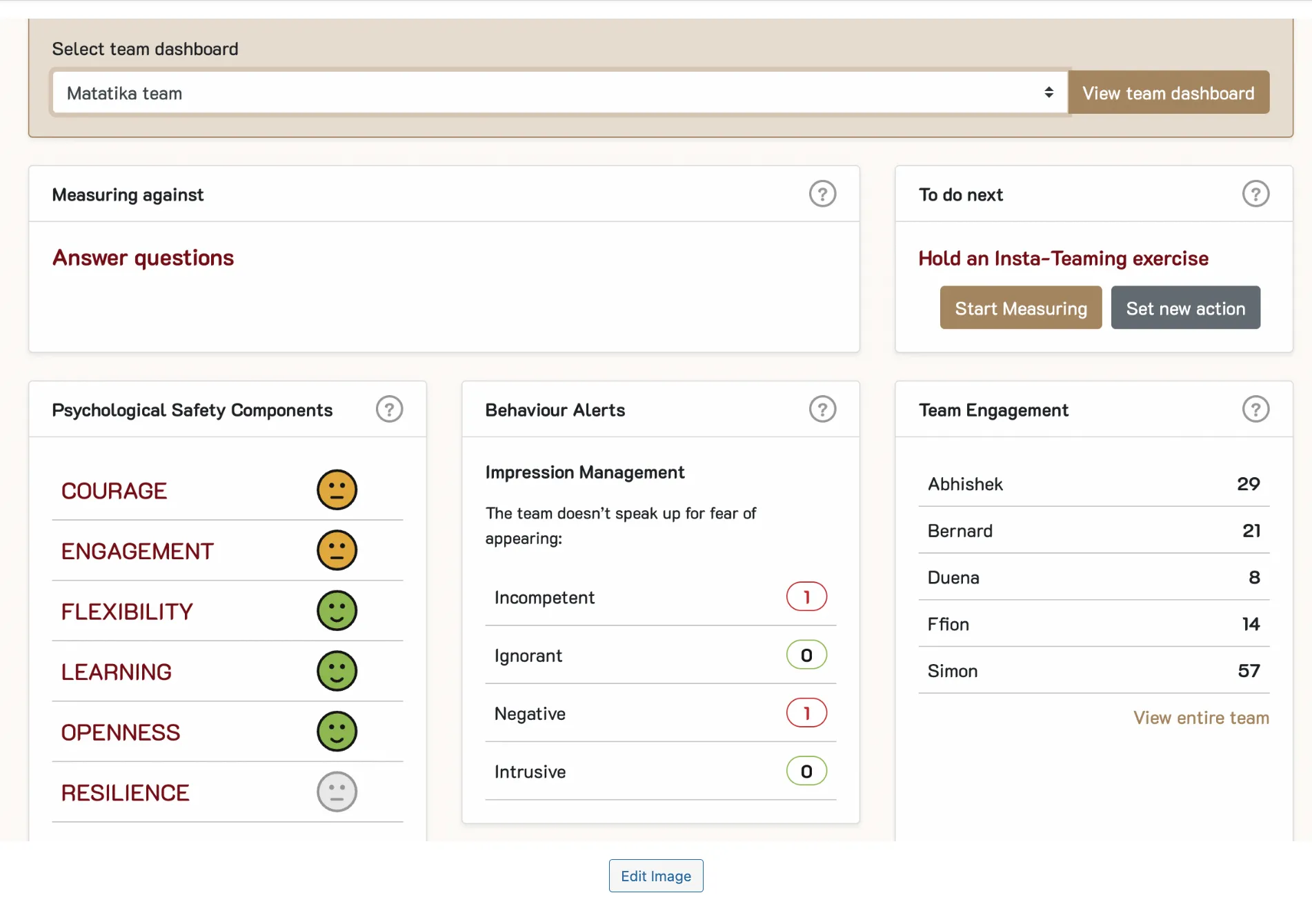

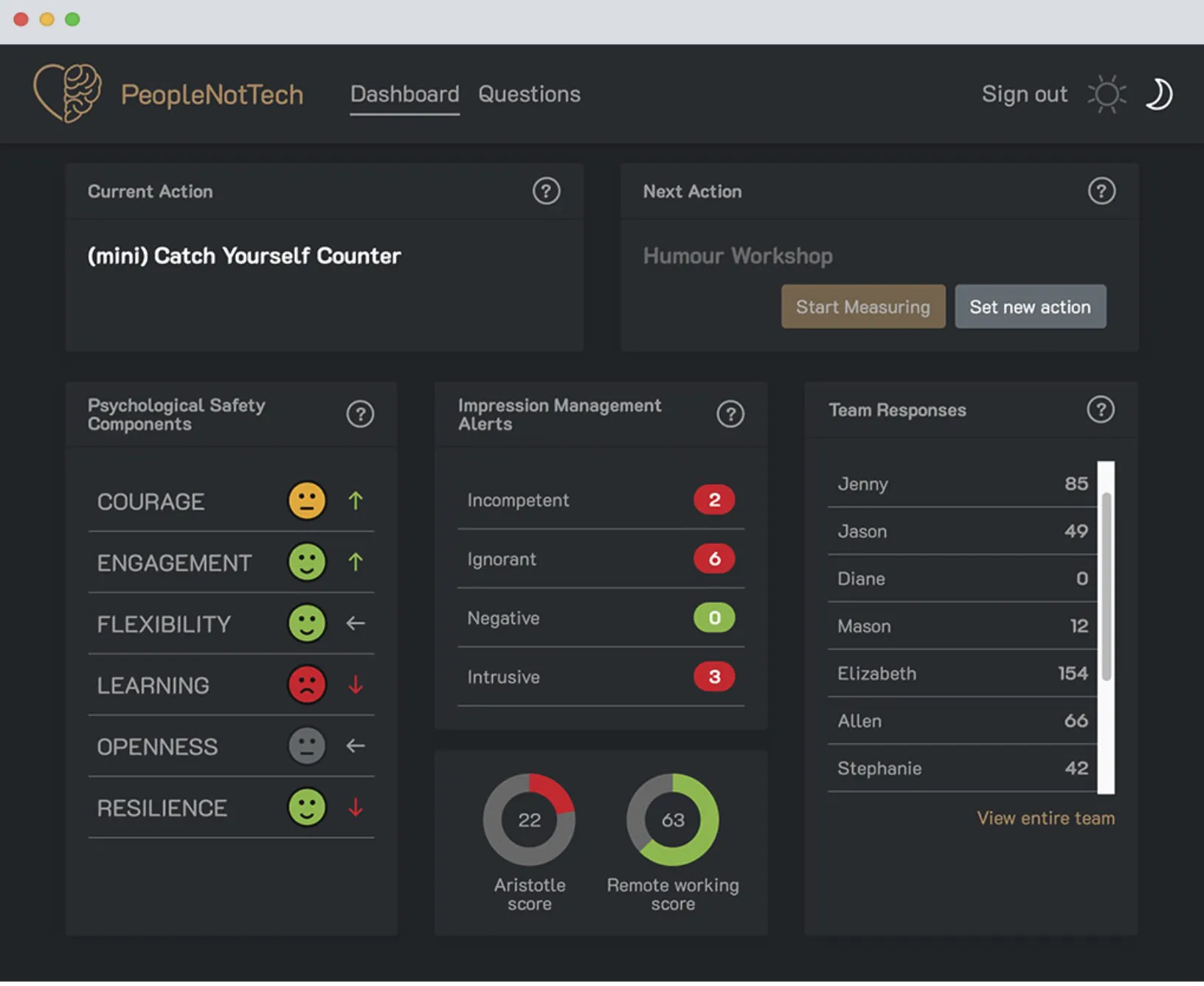

Why does Human Debt™ build?
Human Debt™ builds because organisations measure output but not the human system producing it.
When cognitive load, silence, and compensation behaviours go untracked, risk compounds without signal. People absorb pressure instead of surfacing it. Decisions degrade before anyone notices.
AI accelerates this. It increases speed without increasing alignment — which amplifies structural weaknesses that were already present but invisible.
Unmanaged Human Debt™ Consequences
Unmanaged Human Debt™ doesn't slow organisations down in the AI era — it devastates them
AI Adoption Resistance
Progress stalls as teams resist change
Dangerous Tech Debt
Immeasurable and accumulating technical risk
Transformation Drift
Strategic initiatives get derailed
Latent Errors
Silent undermining of operations
Compliance Breaches
Leading to severe penalties
Attrition Spikes
Depleting talent and morale
What happens if Human Debt™ is not addressed?
Unaddressed Human Debt™ degrades execution capacity over time.
AI programmes stall. Transformation initiatives produce activity without outcomes. People compensate silently until the system fails visibly — at which point recovery cost has already multiplied.
Human Debt™ left unmanaged leads to Execution Debt — the compound failure state where neither the human system nor the technical system can be trusted to deliver.
What We Provide
PeopleNotTech applies Human Debt™ institutionally.
Delivered by trained execution teams, our system provides:
Real-time Behavioural Telemetry
Continuous measurement of human system health across teams and programmes
Early Warning Diagnostics
Detect emerging risk signals before they become visible failures
Board-Ready Risk Visibility
Governance-grade reporting for executives, boards, and risk committees
AI-Assisted Signal Detection
Machine learning surfaces silence, masking, and emerging failure patterns
Psychological Safety as an Execution Constraint
Treating psychological safety as infrastructure, not aspiration
This is not workshop facilitation.
It is human risk infrastructure embedded inside live environments.
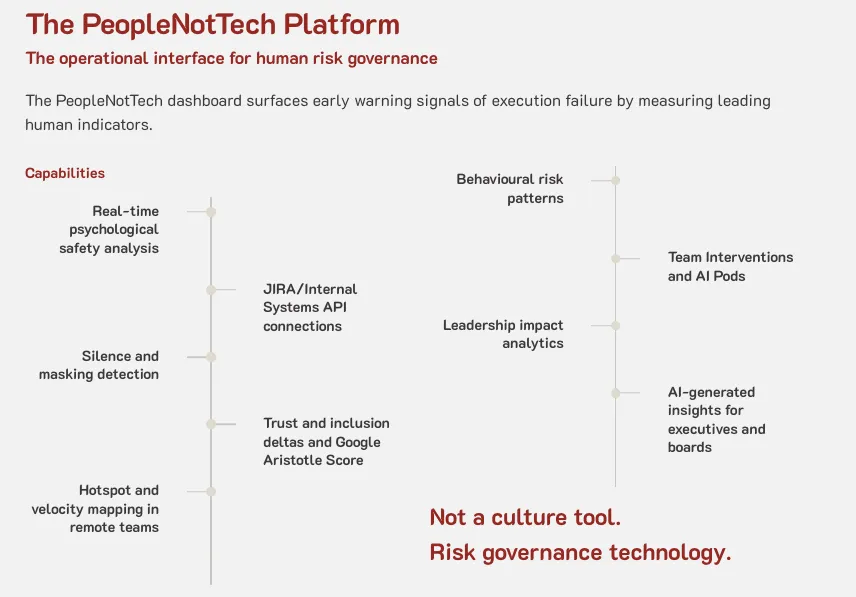
What Leaders Can Do
- Non-observable failure patterns
- Behavioural resistance
- Transformation drift
- Compliance vulnerabilities
- Human Debt™ levels
- Risk velocity and trendlines
- Thresholds and inflection points
- Impact of leadership actions
- CIO and COO reporting
- Risk committee oversight
- Board-level visibility
- Organisational solvency monitoring
Proven in Practice: From Human Debt™ to Human Risk Infrastructure
Global research now confirms what practitioners recognised early: AI success is constrained by human systems, not tools. PeopleNotTech applies Human Debt™ institutionally — building human risk infrastructure that moves the concept beyond surveys, sentiment tracking, and workshop-based interventions.
PeopleNotTech has been used by leaders across industries including Novartis, Sports Direct, Matatika, and FedEx to detect and prevent execution failure before it impacts outcomes.
Field evidence: FedEx, Novartis, and technical case studies →
How is Human Debt™ resolved?
Human Debt™ is resolved by installing continuous human risk measurement inside live environments — not through surveys, workshops, or engagement programmes.
PeopleNotTech provides governance-grade telemetry. TechLedCulture surfaces team-level signals. Bienestarly delivers implementation toolkits for HR and leadership teams.
This is a system — not a product. Each institution handles a different layer of the same problem.
How failure actually happens
Failure is not sudden. It accumulates.
Execution degrades slowly through invisible gaps. Work is reported but not verified. Dashboards show progress but outcomes diverge.
Your systems are reporting work that isn't happening.
What is Execution Debt?
Execution Debt is the compound failure state created when Human Debt™ and Technical Debt interact under low decision visibility.
Common questions
Why does AI increase Human Debt™?
AI increases speed without increasing alignment, which amplifies structural weaknesses inside organisations.
What replaces traditional teams?
Pods — structured human and AI units designed for execution rather than coordination.
How is Human Debt™ detected?
Through continuous behavioural measurement embedded in live environments. Not surveys. Not workshops.
What happens when Human Debt™ compounds?
It becomes Execution Debt — the state where neither human nor technical systems can be trusted to deliver.
How are Pods monitored?
Through continuous execution measurement via AIAP. Pods and AIAP form a closed loop.
What are Execution Pods?
Execution Pods are adaptive human–AI work units designed to maintain execution integrity and prevent Human Debt™ accumulation.
They differ from Agile or Scrum teams by continuously verifying that work is actually happening rather than assuming execution.
Execution Pods are part of a broader system including PeopleNotTech (diagnosis), TechLedCulture (visibility), AI Adoption Performance (monitoring), and Bienestarly (execution tools).
They represent the next layer after Agile organisational models.
Execution Pods and Human Debt™ — Key Questions
What are Execution Pods?
They are adaptive human–AI work units that continuously verify execution and stop Human Debt™ from compounding.
How are Execution Pods different from Agile teams?
Agile teams coordinate work. Execution Pods continuously verify that work actually happens and does not degrade over time.
What problem do Execution Pods solve?
They prevent execution failure caused by Human Debt™ and Execution Debt by continuously monitoring and adapting how work is performed.
What is execution risk?
Execution risk is the probability that work is reported as completed but not actually happening.
How do you measure execution risk?
Execution risk is measured through structured diagnostics that evaluate alignment, delivery, and verification.
What is Human Debt™?
Human Debt™ is the accumulated cost of misalignment, disengagement, and coordination failure in teams. Left unchecked, it compounds and degrades execution integrity across the organisation.
What to do next
If this reflects your situation, do not stay in analysis.
Choose the next step:
If you need to see what is happening inside teams → TechLedCulture
https://techledculture.com
If you need to implement solutions → Bienestarly
https://bienestarly.com
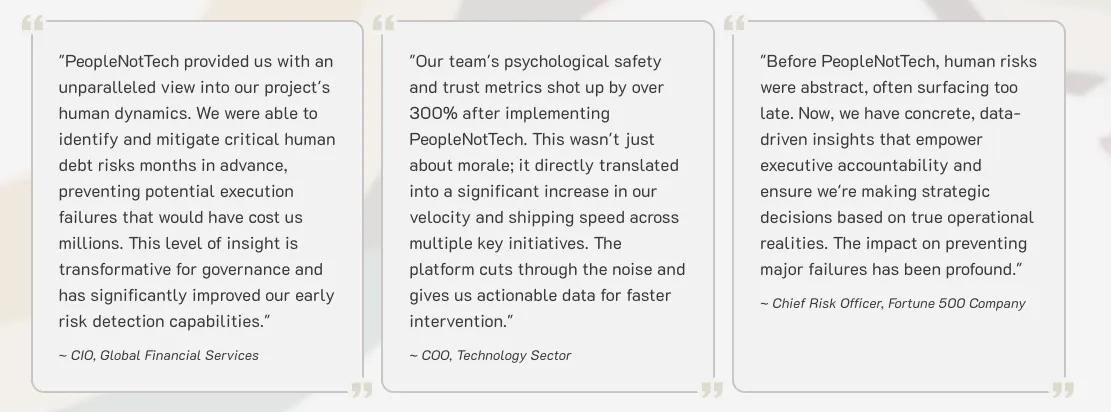
What Leaders Say
Human Debt™
Human Debt™ is the organisational friction that accumulates when teams cannot operate with trust, psychological safety, and clear decision-making.
At PeopleNotTech, Human Debt™ is treated as a diagnostic signal. It explains why execution weakens even when strategy appears sound.
Canonical source: https://duenablomstrom.com/what-is-human-debt
This system is distributed via humanagents.io
This is already costing you
Diagnose it
Your execution risk is already forming. Measure it now.Most organisations discover this too late — after execution has already failed.
See how this appears in teams
techledculture.comApply tools
bienestarly.com/en/toolkitsCommon questions
Why don't surveys fix teams?
Surveys capture perception, not execution. They do not verify whether work is actually happening or whether execution integrity is intact.
How do you measure team performance?
Team performance is measured by observing execution patterns, not reported sentiment. Execution Pods operationalise this by maintaining continuous execution integrity at team level.
What is Human Debt™?
Human Debt™ is the accumulated cost of misalignment, disengagement, and coordination failure in teams. Left unchecked, it compounds and degrades execution integrity across the organisation.